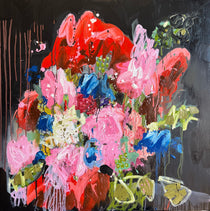

I’ve always been drawn to flowers, but my love of painting them really grew from looking at the extraordinary floral still-life paintings of the 17th-century Dutch and Flemish Old Masters.
There is something about those paintings that completely pulls me in. I love the drama, the dark backgrounds and, above all, the lighting. Flowers seem to glow out of the darkness, with every petal and leaf picked out by the light.
But there is much more going on than simply making a beautiful picture of flowers.
Beauty, life and death
One of the things I find fascinating about 17th-century floral still life is the way beauty and impermanence exist together.
A magnificent bouquet might be at its most beautiful, but look closely and you might find a drooping flower, a fallen petal or a few tiny insects hidden amongst the blooms. These little details could act as reminders that everything living eventually changes and disappears.
I love that tension.
There is something wonderfully dramatic about painting something that is beautiful precisely because it won't stay that way forever.
The darker side
Perhaps some of my attraction to these paintings makes sense when you know that I'm a bit of a Goth at heart.
I've always loved the darker side of things - the drama, the atmosphere and the slightly macabre. I'm also a huge fan of punk and heavy metal music, so I suppose it's not surprising that I'm drawn to flowers with a bit of darkness around them rather than simply painting pretty, cheerful bouquets.
There is something about putting beautiful, delicate flowers against a dark background that feels completely right to me. The contrast makes the colours more intense and the flowers more powerful.
I think that's one of the reasons the Old Masters' paintings resonate with me so much. They can be beautiful and incredibly dramatic at the same time, with that underlying awareness of life, death and the passing of time.
It's a combination I find endlessly interesting - beauty with a darker edge.
The little details
I also love the insects.
You can look at one of these paintings for ages and suddenly notice a tiny butterfly, beetle or fly tucked amongst the flowers. They can completely change the feeling of the painting.
Those small details make the bouquet feel alive. They remind you that flowers aren't isolated objects
arranged for our pleasure - they belong to a living, changing world.
That idea of life and change is something I find myself returning to in my own floral paintings.
Painting flowers from real life
Although I take inspiration from the Old Masters, my way of painting is very much my own.
I often work from real flowers, and one of the things I love about doing that is that they are constantly changing.
A flower can look completely different from one day to the next. Petals open, colours shift, leaves begin to curl and flowers start to droop. Sometimes a flower that looked perfect when I began painting it has changed dramatically by the time I reach the end of the work.
For me, that's part of the excitement.
It gives me endless opportunities for mark making. I can respond to the texture of a petal, the movement of a leaf, a change in colour or the way light falls across the arrangement.
I'm not trying to make every flower look perfect. I'm interested in the energy of the flowers and the marks I can make in response to them.
From Old Masters to something more contemporary
My floral paintings aren't intended to recreate 17th-century Dutch flower paintings. Instead, I'm interested in taking some of the things that drew me to them in the first place - the drama, the lighting, the richness of colour and the sense of beauty and impermanence - and bringing those ideas into my own contemporary paintings.
I work primarily in oil, often combining it with pastel and spray paint. The spray paint brings something completely different to the paintings. It gives them an edge and a slightly urban feel, creating a connection with street culture that sits in contrast to the traditional subject matter.
I love that clash of worlds - the Old Masters and something much more contemporary.
The paint itself becomes part of the energy of the work. I like the contrast between areas that are carefully observed and others that are much looser and more expressive, with layers, marks and unexpected bursts of colour.
That contrast is important to me.
Flowers give you so many possibilities. They can be delicate and beautiful, but they can also be messy, chaotic, dramatic and unpredictable.
And perhaps that's why I keep coming back to them.
Why flowers?
For me, painting flowers isn't really about painting a pretty bouquet.
It's about everything that flowers represent - beauty, change, growth, decay, colour, light and the passing of time.
I love how dramatic flowers can be. I love the way the light can completely transform them. I love the tiny details that can make a painting feel alive. And I love that when I'm working from real flowers, I'm never quite painting the same thing twice.
The flowers are changing while I'm painting them.
And I think that's what keeps them interesting.